
Threat Modelling on Fingertips.
Threat modelling should not stay trapped in workshops or static documents. When a new CVE appears, defensive teams need immediate clarity: what it can enable, which TTPs are involved, what misconfig makes it reachable, what the perimeter should block, and what the SIEM should detect. Chakra-ETI turns CVE intelligence into attacker-path clarity. It maps CVEs to TTPs, behaviours, preconditions, misconfigs, detection gaps, and defensive actions — helping teams block the path, detect movement, and patch with clarity. Threat modelling on fingertips means modelling attacker movement before impact.
7/7/20262 min read
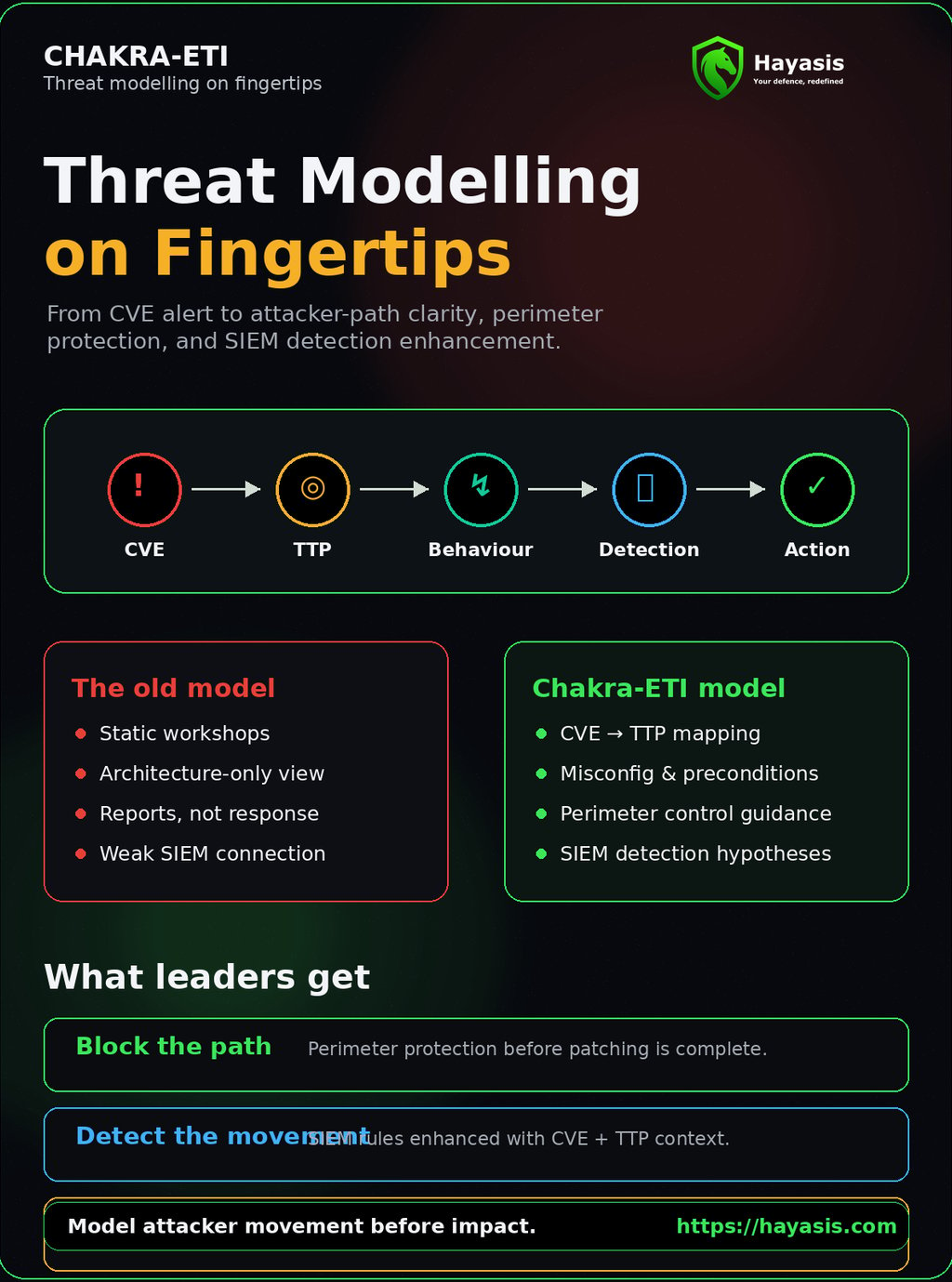
Threat Modelling on Fingertips
How Chakra-ETI turns CVE intelligence into defensive action
Threat modelling has always helped security teams understand what can go wrong in an application, infrastructure, cloud environment, or business system.
Traditionally, it happens through architecture reviews, data-flow diagrams, trust-boundary discussions, STRIDE workshops, and security design documents.
That is useful.
But modern attackers do not wait for the next workshop.
A new CVE appears.
A zero-day starts trending.
Exploit chatter begins.
Attackers start scanning.
SOC teams receive alerts.
Leadership asks: “Are we exposed?”
In that moment, threat modelling cannot remain static. It needs to become immediate, operational, and connected to defensive action.
That is what Chakra-ETI means by:
Threat Modelling on Fingertips.
Not just:
“What could go wrong?”
But:
“How would the attacker move, and where do we stop them?”
Most vulnerability programs treat CVEs as isolated tickets. A scanner finds a CVE, a score is assigned, a remediation ticket is created, and the team waits for patching.
That process is necessary, but incomplete.
Attackers do not think in isolated CVEs. They think in paths.
One CVE may create access.
Another may expose credentials.
A misconfiguration may keep the service reachable.
A weak control may allow movement.
A missing SIEM rule may allow the activity to go unnoticed.
From the Chakra-ETI point of view, a CVE is not just a vulnerability record. It can represent attacker capability, a precondition, a state change, or a pivot point in an attack chain.
Chakra-ETI connects:
CVE → TTP → Behaviour → Detection → Defensive Action
This helps defensive teams answer practical questions:
What attacker technique does this CVE map to?
What behaviour should we expect?
What misconfiguration makes it reachable?
Which perimeter control can reduce exposure?
Which SIEM rule should be enhanced?
Which remediation action breaks the path?
This is where threat modelling becomes operational.
A CVE tells you what weakness exists. A TTP tells you how an attacker may use it. That difference matters for SOC teams, threat hunters, and detection engineers.
If a CVE enables command execution, the SIEM should look for suspicious execution patterns. If it enables credential access, detection should focus on authentication anomalies and credential misuse. If it enables lateral movement, teams should monitor unusual connections, privilege changes, and remote access behaviour.
Chakra-ETI helps translate CVE intelligence into detection hypotheses and SIEM rule enhancement.
It also brings misconfigurations into the model.
A vulnerability is dangerous.
A vulnerability plus misconfiguration is urgent.
An exposed service, open port, permissive firewall rule, weak identity boundary, missing segmentation control, or internet-facing management plane can turn a CVE into a real attacker path.
That is why perimeter protection must be part of threat modelling.
In banking, fintech, and manufacturing environments, patching is rarely instant. There are approval cycles, testing windows, uptime requirements, vendor constraints, and maintenance windows.
But exposure starts immediately.
Chakra-ETI helps teams identify what can be restricted, hardened, monitored, or prioritized before full patching is complete.
For CISOs, VPs of Security, and Directors of Security, the value is decision clarity.
Instead of saying:
“We are reviewing the vulnerability.”
The team can say:
“We mapped the CVE to likely TTPs, identified exposure conditions, checked perimeter controls, enhanced SIEM detection logic, and prioritized remediation based on attacker-path risk.”
That is a stronger answer for leadership, regulators, customers, and the board.
Threat modelling should not stay locked inside documents. It should help defenders act in the moment.
Block the path. Detect the movement. Patch with clarity.
That is Threat Modelling on Fingertips with Chakra-ETI.
Hayasis
Leading the future of cybersecurity with AI-driven solutions, comprehensive threat protection, and innovative security frameworks.
© 2025. All rights reserved.